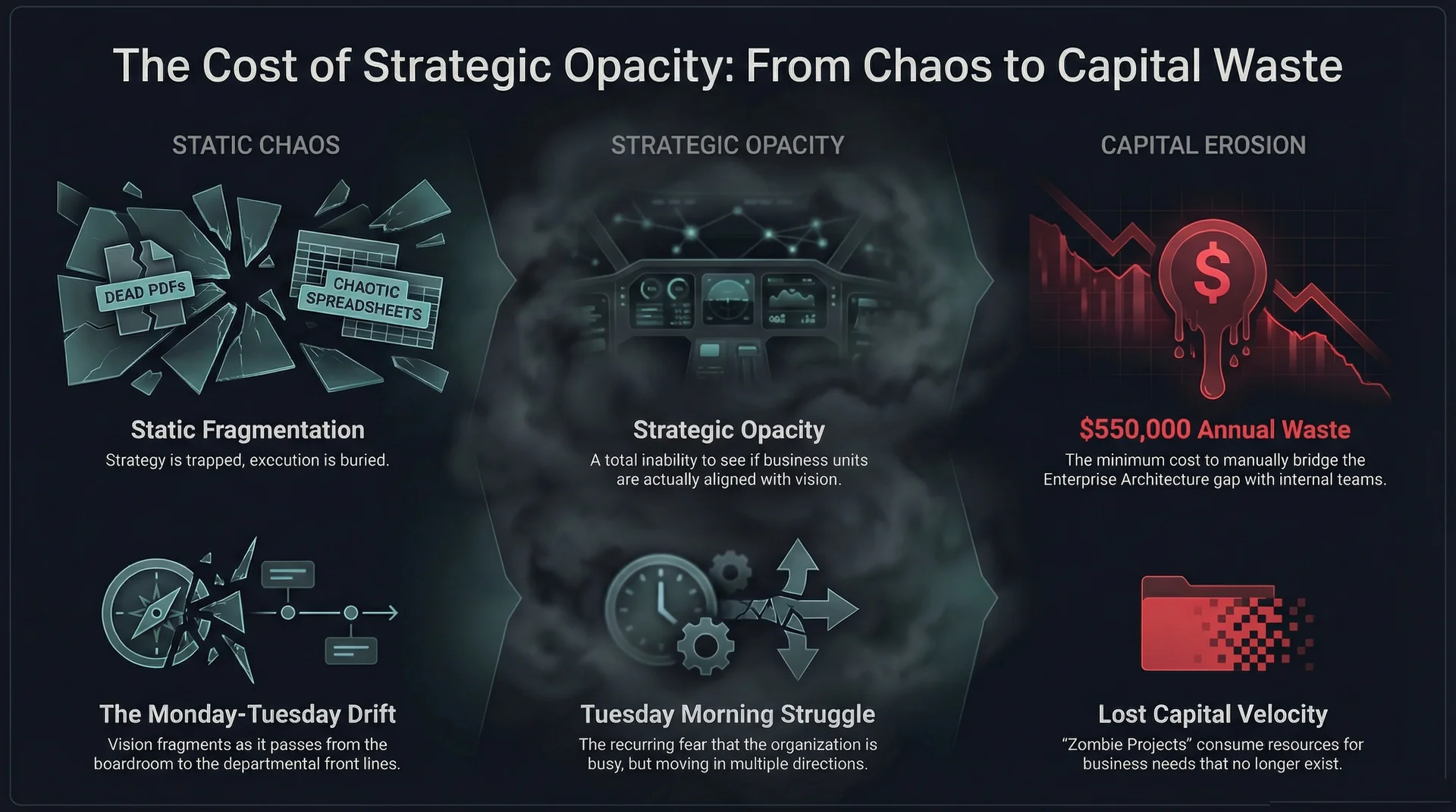
The Tuesday Morning Struggle
Every leader knows this feeling. Monday's board meeting was confident. By Tuesday morning, the doubt creeps in: Is the company actually executing what we agreed? Or is everyone just busy? This is not a productivity problem. It is the natural result of organizational complexity — execution fragments as strategy passes through each layer of your organization. The vision you communicated is being interpreted differently by every VP, every department, every team.
What each leader sees
Same cockpit. Different questions for every role.
CEO / Board
Sees the whole company. Cares about whether the total strategic portfolio is coherent — every Business Unit plan pulling in the same direction, every supporting plan actually funding the ambition.
Own plan circle
Which Business Unit plans are farthest from my strategic priorities?
Alignment to all supporting plans — distance score for each BU plan vs CEO plan, sorted worst-first.
Which of my CEO-level initiatives have no IT/Data/AI/ESG support at all?
Orphan initiatives — with reason codes, ownership, and budget at risk.
Are the future capabilities I'm counting on being delivered on time?
Future capability promises — promised capabilities with owner, target date, and dependency count.
If I fix the top 3 orphan initiatives, how much does the distance shrink?
What-If Simulator — toggle initiatives and recompute distance live.
Arrow to another plan
What specifically is causing the drift between my plan and theirs?
Distance breakdown — per-initiative analysis showing exactly where and why the gap exists.
Who is accountable for closing this gap?
Gap ownership map — initiative owners and plan owners for the unresolved capabilities.
Add this gap to the leadership alignment agenda.
Structured agenda item: plan A, plan B, distance, top 3 gap initiatives.
Another plan circle
What is this team actually working on this cycle?
Their roadmap initiatives — initiative list with status, owner, and budget.
What is this plan's overall orphan risk?
Their orphan exposure — how many initiatives have no funded support, as a percentage.
How aligned is this plan to my CEO priorities?
Compute distance to CEO plan — runs the kernel and shows the score.
CFO / Finance VP
Cares about one thing: are we spending money on things that actually move the strategy? Orphan initiatives are budget waste. Shadow-IT is hidden cost. Unfunded capabilities are liabilities on the balance sheet of strategy.
Own plan circle
How much of our Finance roadmap budget is spent on initiatives with no IT/Data support?
Budget at risk by orphan status — total planned budget on orphan vs supported initiatives.
Are our ERP and FP&A modernisation initiatives supported by the IT and Data plans?
My plan vs IT / Data plan distance — with per-initiative detail on gaps.
Which Finance processes still run on shadow-IT (Excel, SharePoint)?
Shadow-IT exposure — business capabilities whose only IT support is informal tools.
Which Finance initiatives depend on future capabilities that are UNFUNDED?
Future capability promises — filtered to Unfunded and Unselected readiness states.
Arrow to another plan
Why is our distance to the IT plan so high? Which initiatives are the problem?
Initiative-level distance detail — showing which Finance initiatives have zero IT coverage.
What would it cost to close this gap?
Gap capability list — business capabilities with no IT support, mapped to the IT nodes that would cover them.
CIO / IT VP
The IT plan is supposed to enable everyone else. The CIO's unique question is the inverse: not how well does IT support the business, but how much of the business is counting on capabilities not yet delivered. High inbound dependency is delivery pressure. Unfunded capabilities are strategic debt.
Own plan circle
Which business plans depend most heavily on my IT capabilities?
Inbound dependency map — all BU plans ranked by how many of their initiatives need IT-owned capabilities.
Which of my promised future capabilities are blocking the most business initiatives?
Future capability promises — PLANNED/UNFUNDED nodes sorted by dependent initiative count.
Where is shadow-IT filling gaps I should be filling?
Shadow-IT exposure map — capabilities running on Excel/SharePoint, showing what IT capability would replace them.
If I deprioritise initiative X, which business plans get hurt most?
Deprioritisation impact simulator — toggle an IT initiative off, recompute distance to all BU plans live.
Arrow to another plan
Which of their business capabilities am I not covering, and why?
Uncovered capability list — BU business capability nodes with zero coverage from the IT plan.
When will the gap close?
Gap timeline — PLANNED capabilities with target date that cover the gap, sorted by delivery date.
Another plan circle
Do they have initiatives that need capabilities I haven't started building yet?
Their dependency on my future capabilities — their initiatives mapped to my PLANNED/UNFUNDED IT nodes.
Request a joint planning session to close the capability gap.
Sends a structured gap summary to the BU VP with initiative names, capability gaps, and target dates.
Sales VP
Lives and dies by execution speed. Needs CRM consolidation, revenue intelligence, and CS expansion. The question is whether IT, Data, and AI have those in their roadmaps and whether they are funded. The distance score is the answer.
Own plan circle
Which of my Sales initiatives are blocked because IT hasn't committed to the platform yet?
My orphan initiatives — Sales initiatives with UNFUNDED or UNSELECTED readiness in the IT/Data plan.
Is the AI plan building the revenue intelligence and deal coaching tools I need?
Sales plan vs AI plan distance — with per-initiative detail on AI-coverage gaps.
My APAC expansion initiative — which plans need to deliver for it to succeed?
Initiative dependency trace — cross-plan dependencies for a specific initiative.
Arrow to another plan
Is this a funding issue or a prioritisation issue?
Distance breakdown — the platform shows whether the gap is a funding issue, a prioritisation issue, or a missing capability.
Escalate this gap to the CIO with a structured brief.
Gap escalation — initiatives at risk, capabilities missing, and owner names.
Marketing VP
Blocked on two things the cockpit makes clear: the CDP is UNSELECTED (Marketing's first-party data strategy is a full orphan), and the ABM platform depends on the Data team's lakehouse which is also future. Cross-plan dependency hell. The cockpit names it.
Own plan circle
Which of my initiatives are full orphans — no tech stack committed anywhere?
My orphan initiatives — CDP shows UNSELECTED; AI content engine shows no platform chosen.
Which of my initiatives depend on the Data team delivering the lakehouse first?
Cross-plan dependency view — Marketing initiatives with a cross-plan dependency on the Data plan.
Is the ABM / intent-data initiative actually supported by someone's plan?
Initiative IT support trace — which IT/Data nodes support the ABM initiative and their readiness.
Arrow to another plan
The Data team says they'll have the lakehouse by Q4. Does the cockpit confirm that?
Future capability promise — promising plan, target delivery date, current readiness state.
Request a formal dependency acknowledgment from the Data VP.
Structured message with the cross-plan dependency details and the Marketing initiative at risk.
Data VP / AI VP
Their plan enables everyone else. The unique angle: how many BU plans are counting on capabilities they haven't delivered yet? Kafka is UNFUNDED but Marketing, Products, and Sales all depend on it. The cockpit makes that cross-company exposure visible.
Own plan circle
How many BU plans are counting on my future capabilities?
Future capability promises — inbound dependency rank, PLANNED nodes sorted by dependent initiative count.
Which of my promised capabilities are UNFUNDED and causing orphan risk across the company?
Unfunded capability alert — future nodes with UNFUNDED state and count of dependent initiatives.
If I fund the Kafka initiative, which plans' distance scores improve and by how much?
Fund-and-recompute simulator — toggle Kafka from UNFUNDED to FUNDED_IN_FLIGHT, recompute all distances live.
Where is shadow-ChatGPT being used because we haven't delivered the AI gateway yet?
Shadow-AI exposure — shadow-IT view filtered to AI nodes (Shadow ChatGPT, Google Sheets AI ROI).
ESG VP
ESG is the most orphan-heavy plan in the portfolio. Watershed is funded but tight. EcoVadis is budget-at-risk. CSRD reporting today runs on PowerPoint. The cockpit is the ESG VP's evidence for why the investment is non-negotiable.
Own plan circle
Which ESG commitments are at risk because the platform budget was cut?
ESG orphan initiatives — Supplier ESG Scorecard shows FUNDED_AT_RISK; CSRD shows SHADOW_SUPPORT.
Today we produce ESG board reports in PowerPoint. Where should that capability live?
Shadow-IT exposure — PowerPoint Board ESG Reports shown as MARGINAL support for Carbon Accounting and CSRD.
Build the business case: how does funding Watershed change our ESG distance score?
What-If Simulator — toggle from FUNDED_AT_RISK to FUNDED_IN_FLIGHT, show new distance score.
Operations / Supply Chain VP
Execution-focused. The Autonomous Logistics initiative is a full orphan — no robotics platform on the table anywhere. Google Sheets tracks supplier risk. The cockpit exposes the operational risk hiding in shadow-IT before it becomes a crisis.
Own plan circle
Which logistics initiatives are pure orphans — no platform committed anywhere?
My orphan initiatives — Autonomous Logistics shows as orphan (legacy WMS only, no robotics platform in the IT inventory).
Is our supplier risk management running on Google Sheets?
Shadow-IT exposure — Google Sheets Supplier Risk Tracker shown as MARGINAL for Dual-Sourcing and ESG Scoring.
When will the Kinaxis S&OP and Project44 visibility platforms be live?
Future capability promises — Kinaxis and Project44 with target dates and current readiness states.
Arrow to another plan
The autonomous warehouse initiative — can IT and Data actually deliver what it needs?
Initiative IT support trace — Autonomous Logistics: no CURRENT_SUPPORT or PLANNED_SUPPORT rows. Full orphan confirmed. Escalate.
What is Strategic Opacity?
Strategic Opacity is the inability to see whether your organization is aligned. Plans exist in PDFs. Execution exists in spreadsheets. The connection between them is invisible. Decisions are made in business units that contradict the strategic plan, and no one catches it until months later.
The Real Cost of Not Knowing
Strategic Opacity costs enterprises over $550,000 per year in manual Enterprise Architecture teams — and most growth-stage businesses can't afford that team at all.
They fly blind. MyStratos closes this gap for approximately 3% of that cost.
The Drift is Already Happening
- → You are detached from your strategic course without recognizing it.
- → You are mistaking motion for progress and becoming a passenger in your own journey.
- → Strategic Opacity is eroding your capital velocity every quarter it goes unaddressed.
- → Recovery from this drift becomes exponentially harder with time.